
Feelings
Published:
Feelings are there to tell us something about a situation, and to guide us toward an “appropriate” action in that situation.
If they ever hint at something other than “appropriate action”, then maybe we are not listening well.
Feelings are ancient. They are as ancient as the first cell. They developed to help us navigate life. They are sensations that tell us what is good for us and what is not.
A cell senses sunlight and moves towards it. Its sensation helped it know that there is a source of warmth and energy, and that it would be a good idea to move towards it.
A cell feels cold, so it shrinks. Its sensation told it that it’s better to curl up to preserve heat.
A deer glimpses a lion, panics, and gets filled with fear, so it runs. Its sensation told it that there is danger around, and that it’s better to leave the place to preserve itself.
A toddler, surrounded by kind people, feels safe and calm, so they start exploring the world around them. They touch electrical sockets, they spread flour on the floor, and they run around, carefree. Their sensation told them that they are safe, and so, they are free to explore and to open up to the world.
A cell, a deer, a lion, and a toddler. They are all missing something.
Something that adult humans proudly have.
They don’t have thoughts. They don’t have stories.
They only have biological facts.
The cell does not “think” that there is a source of light. The cell “senses” it.
The deer does not “think” that there is a lion; the deer “hears” it.
The toddler does not “think” that people are kind; the toddler “experiences” it.
In all these ancestral forms of our current existence, the cells of our bodies did not need to think. They only needed to feel. To see, to listen, to sense.
We are a body and a mind.
Our bodies have been evolving for billions of years. They have been learning and perfecting the methods of survival. They have been passing their knowledge generation after generation until they arrived at us.
But our cerebral cortex has been evolving only for hundreds of millennia.
Our “thoughts” are still in infancy relative to the age of our bodies.
Whatever one thinks our brains are capable of… it’s almost nothing compared to what our bodies have done.
Our brains still have a long way to go until they evolve in as sturdy a direction as our bodies did.
Right now, we live in an age where thoughts and feelings are intertwining:
a brain that found itself capable of steering a body, but with no clue how.
The body and the brain are yet to learn how to communicate together.
The more powerful the brain’s capacity for thought gets, the harder communication with the body gets.
The brain comes with this innate notion that it is wise. That it “knows”. And so, when the body speaks, and the brain fails to interpret it correctly, the brain claims superiority and reigns.
Our bodies still do the same things they have been doing for millions of years.
They feel warmth, so they approach. They feel cold, so they curl. They feel danger, so they run. They feel safe, so they explore.
If we were in our ancestral settings with nature and “traditional” threats, it would have been easier to map between our feelings and their source.
We would fear a lion and feel the warmth of the sun.
The link between what happens in our bodies and what is outside was quite linear.
But we “evolved” to make communities. To build houses and factories and skyscrapers. We “evolved” to never know cold again. To never fear a lion in a lifetime.
We evolved to “transcend” all that once held us hostage in the jungles and deserts.
This was the doing of our brains. Our mighty intelligent brains.
Our brains managed to remove the “traditional” sources of fear and worry, so that we enjoy the earthly heavens.
But what about our bodies?
Our bodies still feel. Every cell still senses. A cell has been sensing for millions of years. Our mighty brains changed our environment in a mere ten millennia. Can ten millennia overwrite millions of years?
We steered away from traditional danger and formed communities. There is no longer a lion lurking around, but it was the community that made this possible. If one is not in a community, one is in danger of possible encounters with a lion.
Our brains rewrite the meaning of danger from “lion” to “social isolation”. But our bodies did not rewrite their sensation. The neurochemicals released when facing a lion will be the same ones released when facing social isolation.
The brain hijacked the neural circuit and redirected it, but the cell did not modify its sensation.
There is an intermediate step between social isolation and facing a lion. The earlier still permits some time to take action. But our bodies do not account for this yet.
The fear of a lion will feel the same as the fear of alienation.
If fear of a lion calls for running away from the source of danger, fear of isolation will call for running away as well.
But… run away how? What exactly to run away from? And to where?
The brain hijacked the system to reach its goal, but it did not know exactly how to handle this hijack.
The cells of the body want to run away. The brain looks around and sees no lions. Yet the body still says “run”.
The brain finds itself in a conundrum. The body does not release its tension because the brain does not know where to steer the body. It does not know how to calm the body’s imagined lion. So, the brain creates a story for the body—a story of interpretation.
The brain tells the body that its fear is because this person spoke to them in this tone. To survive this danger, one either asserts dominance or retreats with humility. Doing this will help avoid the danger of alienation, so, calm down and rest.
With every new sensation that erupts, the body needs the corresponding action. The brain looks around and does not see what the body expected. The brain creates a new story and tells it to the body to relieve it.
At some point, each individual got to experience the power of interpretation, and each individual got to make their own version with each new situation.
The source of sensation became an elusive motive, and the stories became intricate.
Now, we worry because we don’t know how life will look two years from now. We fear that this person will not like us. We get angry because the meeting did not go as we planned. We feel sad because this day was hard, and there was no one next to us when the day was over.
Currently, feelings emerge from subtle cues in our environment, then they linger and amplify because of the stories. Made-up stories that the brain once learned to create to calm the body down. Made-up stories that awaken the same ancient feelings.
The longer we stay unaware that the stories are stories, our bodies will feel their feelings, and the stories will feel real. As real as a lion.
When one is afraid of being disliked,
when one is afraid of the person who abuses them, when one is afraid of the economic decline,
when one is afraid of existential dread,
when one is afraid of a bomb in the middle of the war,
these are different stories, and all of them come with the same exact sensation. They all feel as if one is facing a lion. Because our bodies still know only one way to encode fear.
When I first got introduced to the wheel of emotions1, it felt revolutionary.
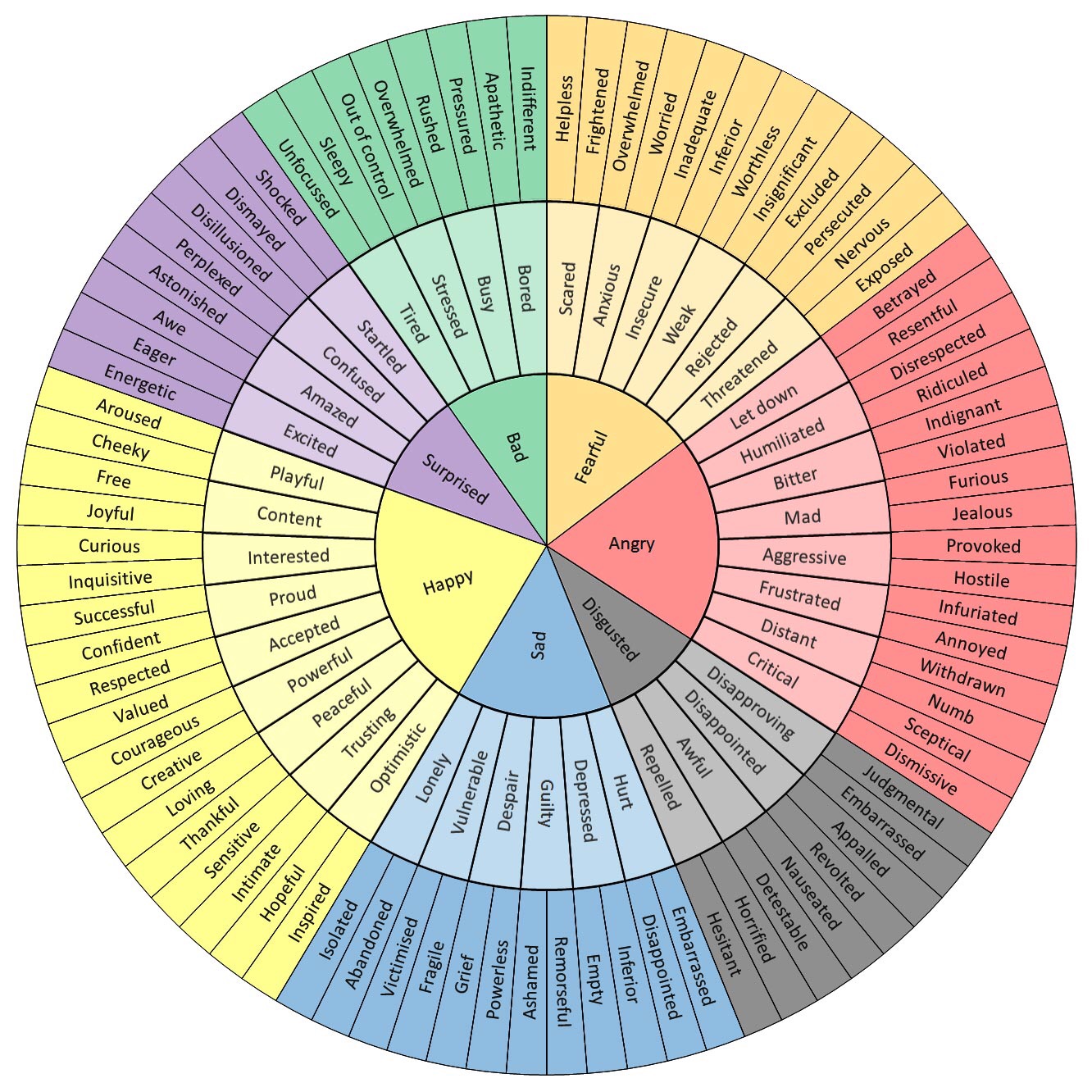
For the first time, I found a way to trace back my feelings and name them. Once named, they helped me greatly in calming my body.
But now I am realizing how this wheel is encoding the stories our brains created over the years.
The inner circle is the basic feelings—the feelings of a cell, a deer, and a toddler.
The outer circles are names that reveal the story behind it.
Fear → scared → frightened: this is a traditional feeling of facing a lion.
Fear → scared → helpless: this is a story of assuming control over events, and then feeling helpless because, in a certain situation, one is not.
Fear → insecure → inadequate: this is a story of a community that values its individuals based on their adequacy, and in a certain situation one fell short of meeting the community standards.
Fear → insecure → inferior: this is a story of competition and hierarchy, and in a certain situation one felt defeated.
All the branching feelings of fear are telling different stories. Yet, they are still fear. They all activate the same ancient sensation. They all feel the same in the body.
The stories were made by the brain to push us towards development. Competition was there to ensure progress. Adequacy was there to ensure a dependable community that will make it to the end of progress. Assuming control was there to avoid despair of our true position in the universe.
All these stories were vital for our brains to get to where we are now: to build the houses, the factories, and the skyscrapers.
But the more the stories, the longer the sensations stay in the body.
We used to feel fear only when there was a lion around. Now, we can feel fear for many prolonged hours in a day, and days in a week.
The longer the stories linger in our bodies, the longer the feelings will be there.
And our bodies will not differentiate. Fear is fear. Anger is anger. Happiness is happiness. The story does not matter to the body.
I “fear” that the wheel will only expand if we do not stop the flood of stories. The more stories we make, the more progress we achieve. But until when are we going to overwhelm our bodies? Until when are we going to deprive them of clarity?
Our bodies need to adjust as our brains did. Our bodies need to learn new sensations to help us navigate our modern life.
Fear needs to start coming in different doses. Feeling inferior in a single situation should feel way less threatening than facing a lion. One would not die if one felt inferior occasionally. We will feel inferior occasionally because we are not as mighty as our brains make us believe. We are humans who get to play both the role of god, and the role of a poor peasant. An incident of inferiority every now and then does not cast one into the role of an eternal poor peasant, just as an incident of superiority every now and then does not cast one into the role of an eternal god.
Feelings will come and go. Every situation in every day will make us feel a feeling.
So far, the feelings are as strong as they used to be a million years ago. But they need not be.
One can allow them to come and go. One can learn how to relieve the body without creating new stories.
If I feel playful, maybe I dance. If I feel stressed, maybe I meditate. If I feel rejected, maybe I go to nature and gain perspective.
Feelings are there to help us navigate life. They helped us navigate a life in the wilderness, but now we are no longer there.
Our young brains mastered the power of stories to help us build, but also to soothe our bodies. But our bodies were not built to listen to stories; they were built to take action.
One can name the feeling, catch the story, remind oneself it is just a story, figure out what actions would help relieve the body, and trust that the feeling will go away.
Once a deer runs away, the lion is not there anymore.
Once I meditate, I remind my body that there is always time, and the stress goes away. Once I wander in nature, I remind my body that the world is bigger than what I “think”, and the rejection goes away. Once I dance, my body feels aligned, and the dopamine high finds a way.
Feelings are here to help us act. Most of the time, these actions only need to be mild and simple, because not all feelings are equal.
One needs to find a way to label the severity of the feeling, so that running away is reserved only for lion-like situations, not every fearful situation.
So that committing to lifetime decisions is reserved for grand moments, not every happy feeling. So that passing judgment is reserved for high-stakes situations, not an everyday urge.
We were once a simple creature in the wilderness with a limited set of feelings, a limited set of situations where these feelings get evoked, and a limited set of actions to deal with each feeling in each situation.
We acquired a powerful brain that increased the number of situations exponentially; however, our poor bodies still have the same limited set of actions.
One needs to invest less in the stories, and more in finding actions, until one reaches a sweet balance between mighty brains and wise bodies.
Torre, Jared B., and Matthew D. Lieberman. “Putting feelings into words: Affect labeling as implicit emotion regulation.” Emotion Review 10.2 (2018): 116-124. ↩